Leather and pets are a rough combination. The material looks good on day one, but a single claw, even from a dog that was just excited to see you, can leave marks that don’t come out. Deep punctures can’t usually be repaired without visible patches, and surface scratches compound fast on high-gloss leather. For most pet owners, the frustration isn’t dramatic destruction; it’s the slow accumulation of damage that makes a couch look worn long before it should.
You don’t have to pick between your pets and furniture that lasts. The real decision is about materials: what something is made of determines how it handles claws, weight, and the general chaos that comes with animals in the house. Amish-built furniture, constructed from solid hardwoods with joinery that doesn’t rely on glue and staples, holds up in ways that mass-produced alternatives don’t.
The Vulnerability of Leather
Leather’s main problem isn’t that it’s soft, it’s that claw punctures are nearly impossible to fix without visible evidence of the repair. Surface scratches accumulate in the finish over time, and even a calm, well-trained dog can scuff the surface just by jumping up or settling in. Some protected leathers resist light abrasion better than standard full-grain, but none are truly claw-proof. Most pet owners who go with leather end up covering it or replacing it earlier than expected.
Solid Wood: The Foundation of Pet-Friendly Furniture
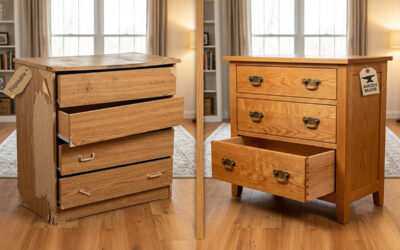
Solid wood is the most practical base for furniture in a home with pets. Particleboard and veneer surfaces chip, peel, and delaminate when damaged, once that happens, the piece is essentially done. A scratch on solid wood is just a scratch on a solid surface. Depending on the species and finish, you can sand and refinish it yourself, or have a furniture restorer address it without replacing the whole piece.
Wood hardness matters a lot in a home with pets. Harder species resist dents and surface scratches better, and they hold their finish longer under daily use. A few that work well:
- Oak: Red Oak sits at 1,290 on the Janka hardness scale, hard enough to handle daily pet traffic without showing it. The heavy, open grain also makes minor scuffs less obvious than they’d be on a smoother wood. It’s a reliable choice for dining tables, coffee tables, and desks that see constant use.
- Hickory: Hickory measures around 1,820 on the Janka scale, making it one of the hardest domestic hardwoods available in furniture. It can take real abuse without denting easily. The pronounced grain variation, light and dark streaks running through the same board, also does a decent job of visually absorbing small scratches that would stand out on a more uniform wood.
- Brown Maple: Brown Maple lands lower on the hardness scale than Oak, but its dense, tight grain means it doesn’t show wear the way open-grain woods do. It’s a practical choice for everyday furniture, and it accepts stain evenly, which means you can go with a darker finish that helps hide surface marks over time.
Solid hardwood entertainment centers, bookcases, and tables hold up to real household life, including pets. When the frame is hardwood through and through, a scratch stays a scratch rather than becoming a chip that exposes particleboard. You get furniture that looks good now and survives the next decade of dogs, cats, and everything else.
Upholstery That Performs
Wood frames only get you halfway, upholstery matters just as much. Moving away from leather doesn’t mean settling. Amish craftspeople who build custom frames to order can fit those same pieces with fabrics chosen specifically for households with animals, so the seat cushion holds up as long as the joints do.
Performance fabrics are the practical first choice. Engineered to resist stains, moisture, and abrasion, they shed spills rather than absorbing them, most liquids bead on the surface long enough to wipe away cleanly. The tight weave also resists snagging; a cat’s claw slides off rather than catching a thread and pulling it loose.
Microfiber works on similar principles. Its dense fiber structure doesn’t give claws much to grab. Pet hair behaves differently on microfiber than on woven textiles, it sits on top instead of working its way in, so a lint roller or quick vacuum pass actually clears it rather than just redistributing it.
When ordering a custom dining set or accent chairs, ask the maker which performance and microfiber options they stock. The selection has grown considerably, and the right fabric choice eliminates most of the anxiety around keeping upholstered pieces in a home with animals.
FAQs
What is the best wood for a home with pets?
Oak and Hickory are the strongest performers. Both score high on the Janka hardness scale, which measures resistance to denting and surface wear, Oak sits around 1,290 lbf, Hickory around 1,820 lbf. That density translates directly to scratch and dent resistance under daily pet activity. Brown Maple is a step below those two in hardness but still outperforms most domestic species, and its tight, smooth grain is easier to refinish cleanly when the time comes.
Can scratches on solid wood Amish furniture be fixed?
Yes, and this is the practical advantage solid wood has over veneered alternatives. A veneer scratch can break through to a different material underneath, leaving a repair that’s visible no matter what you do. With solid wood, a scratch is just a shallow cut into the same material all the way down. Light surface marks respond well to touch-up markers matched to the finish color. Deeper gouges can be sanded back and refinished, returning the surface to close to its original condition. The piece doesn’t need to be replaced, just restored.
How do I clean pet messes off my Amish furniture?
Speed matters more than technique. On solid wood with a catalyzed finish, wipe the area promptly with a soft damp cloth, then follow with a dry one. The longer a liquid sits, the more likely it is to work past the finish into the wood. Skip chemical cleaners and abrasive scrubbers, both can dull or break down the protective coating. For performance fabric upholstery, blot rather than rub to avoid spreading the stain, then clean with a mild soap-and-water solution. Check the fabric manufacturer’s care label first; specific fiber types sometimes have different requirements.
Are certain furniture finishes better for homes with pets?
Yes, and the difference is measurable. A catalyzed conversion varnish, standard on most quality Amish pieces today, cures through a chemical reaction rather than simple evaporation, producing a hard shell that resists moisture, household chemicals, and surface abrasion. A basic lacquer finish is softer and more vulnerable to both spills and scuffs. For a pet household, the catalyzed finish isn’t a luxury upgrade; it’s the reason the wood underneath stays protected when accidents happen.
Is leather ever a good option for homes with pets?
It depends on the pet. Small dogs with trimmed nails that stay off furniture are usually fine, leather holds up well against incidental contact. The real risk is claws: a cat can shred a leather cushion in an afternoon, and a large dog jumping up leaves drag marks that won’t buff out. For households with cats or bigger dogs, solid wood frames and performance fabrics are the more practical starting point.
What type of wood is most durable for pet-friendly furniture?
Hickory, white oak, and hard maple are the top performers. Hickory scores around 1,820 on the Janka hardness scale, one of the hardest domestic hardwoods available, and resists surface denting and nail drag better than softer species. White oak (1,360 Janka) and hard maple (1,450 Janka) are close behind and widely used in Amish furniture construction. Pine and poplar dent under relatively light impact, so they’re worth avoiding in active households.
Can scratched wood furniture be repaired?
Yes, and this is one of solid wood’s clearest advantages over veneered or engineered alternatives. Light scratches typically buff out with paste wax or fine steel wool. Deeper gouges can be sanded down and refinished, either spot-treated or full-surface, depending on how well the stain matches. A veneered piece can’t be sanded without burning through to the substrate, so damage there is usually permanent.
Are performance fabrics suitable for commercial spaces?
Yes, many were engineered specifically for that context. Brands like Crypton and Sunbrella carry ratings above 100,000 double-rub cycles, well past the 15,000-cycle threshold typically required for heavy commercial use. They resist staining, moisture absorption, and microbial growth, which matters in hospitality and healthcare settings where upholstery gets cleaned frequently and hard.
Does custom Amish furniture take longer to receive?
Generally yes, most custom pieces take 8 to 16 weeks depending on the shop’s current queue and the complexity of the order. That’s slower than pulling something off a showroom floor, but the tradeoff is a piece built to your exact dimensions, chosen wood species, and finish rather than adjusted to fit a catalog size. For furniture you intend to keep for decades, the lead time is a reasonable exchange.
Building a Pet-Friendly Home with Heirloom Furniture
Hickory and white oak resist everyday pet wear in ways that particleboard-core pieces simply can’t. Solid construction means you can refinish a scratched surface rather than replace the whole piece. Performance fabrics give you the softness of upholstery without dreading the next spill or claw swipe. If you want furniture that outlasts the pets themselves, and the kids after them, Amish hardwood construction is one of the few categories where the quality claim genuinely matches the product.
If you’re ready to stop replacing furniture every few years, reach out to our team. We can walk you through custom solid wood options built to your space, your finish preference, and the particular demands your household puts on furniture.