Every detail communicates something. Your website, your staff, and your responsiveness are all read by clients before they decide whether to trust you. But the physical space where you actually meet them is one of the most immediate signals you send, and most businesses treat it as an afterthought. Standard furniture from big-box retailers does the job. It holds things. What it doesn’t do is tell anyone you’re serious about quality or in business for the long term, because it’s designed to be replaced, not remembered.
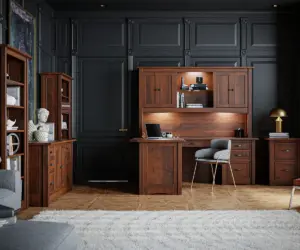
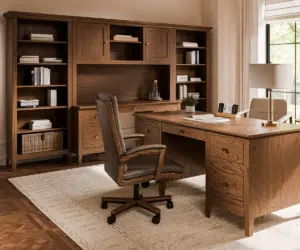
When the goal is to project stability, furniture becomes a real business decision. Custom Amish office furniture is built to your specifications from solid hardwoods, no particleboard cores, no veneer that delaminates in five years. You choose the wood species, the dimensions, and the drawer configuration. The result is a workspace that fits your actual work, not a generic floor plan designed for someone else’s office.
1. The Power of a First Impression
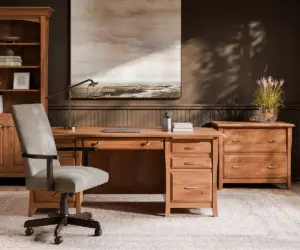
Think about a client walking in for the first time, or a candidate you’re trying to recruit. They’re reading the room before you say a word. A desk built from solid Red Oak or a conference table in Brown Maple registers differently than a melamine-laminate surface from an office supply catalog. One signals the company buys for longevity. The other signals it bought what was on sale.
This isn’t nostalgia for hand-cut joinery. It’s about what solid wood signals to people who notice materials, and the clients most worth impressing usually notice. Law firms, financial advisors, and medical practices all operate in environments where the space itself is part of the credibility they’re selling. A well-built office doesn’t announce its quality; it just makes cheap alternatives look cheap by comparison.
2. Tailored for Workflow
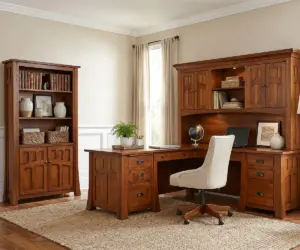
Off-the-shelf furniture assumes you’ll work around it. Desks come in standard widths, standard heights, and standard drawer configurations, designed for the average office, not yours. If your workflow doesn’t match the average, you end up adapting to the furniture instead of the other way around.
- Fit to your actual floor plan. If your office is an L-shape, a corner room with angled walls, or a space where you need eight workstations in 400 square feet, standard furniture means wasted corners or awkward gaps. Custom pieces are built to the inch, no filler panels, no dead zones.
- Configured for how you actually work. If you need file drawers on the left, a locking drawer in the center, and a pull-out keyboard tray on the right, that’s what gets built. Wire management grommets, CPU cabinets, printer shelves, these aren’t afterthoughts bolted on later. They’re part of the original design.
- Built to the right height for the person using it. Standard desks are 29-30 inches high, which works for some people but isn’t ideal for others. A custom desk can be built at 28 inches for a shorter user, 32 inches for someone taller, or designed as a full standing-height surface at 42-44 inches, a difference that adds up over eight hours a day.
When furniture fits the person and the work, the friction disappears. The right drawer in reach, cables out of the way, enough surface to spread out without crowding, a workspace that doesn’t fight you.
3. A Sound Financial Investment
The low price tag is usually the main appeal of standard office furniture, and often the only one. These pieces predictably fail: laminate lifts at the edges within a few years, drawer slides start to bind, and leg joints loosen under daily use. The result is a replacement cycle that runs every three to five years for most offices.
Custom Amish office furniture runs on a different economic logic. It’s built from solid hardwoods, red oak, cherry, quarter-sawn white oak, using dovetail drawers and mortise-and-tenon frames rather than cam locks and staples.
The finish matters too: the catalyzed conversion varnish that Amish shops apply cures harder than standard lacquer, resisting scratches, spills, and the steady friction of daily desk work.
The upfront cost is higher, but the math changes when you buy once rather than replace every few years. A desk built this way can stay in service for 30 or 40 years; the per-year cost ends up lower than the mass-market replacement cycle by a wide margin.
FAQs
How does the cost of custom Amish office furniture compare to commercial-grade alternatives?
Upfront, custom Amish pieces cost more than mass-produced office furniture, but they often land close to what you’d pay for high-end commercial systems from brands like Herman Miller or Knoll. The difference becomes clearer over time. Standard laminate furniture typically needs replacing every five to seven years; solid hardwood built with traditional joinery routinely outlasts two or three of those cycles. When replacement costs are factored in over a 20- to 30-year horizon, Amish furniture frequently proves the more economical choice.
What aspects of a desk or credenza can be customized?
Most of the piece, start to finish. Dimensions, width, depth, and height are set to your specs. You choose the wood species (red oak, hickory, hard maple, and cherry are common options), the stain color, and the topcoat sheen. Hardware like drawer pulls and knobs can be matched to your office aesthetic. Internal layout is also adjustable: number of drawers, door vs. open shelving, and file drawer placement. Practical add-ons like keyboard trays and power grommets can be built in during construction, which is cleaner than retrofitting them later.
Is solid wood furniture practical for a busy office environment?
Yes. The finish does most of the protective work: Amish shops typically apply a post-catalyzed conversion varnish, which cures to a harder, more chemically resistant surface than standard lacquer. It handles water, most common cleaning sprays, and normal scuffing without deteriorating quickly. Maintenance is minimal; dust regularly, wipe spills promptly, and clean with a soft cloth as needed. The wood itself doesn’t flex or rack the way composite materials do under load, which keeps drawers and doors operating smoothly over years of daily use.
What is the typical lead time for a custom office furniture order?
Lead times vary by shop and piece complexity, but six to twelve weeks is a reasonable working estimate for most custom orders. A large executive desk with specialty dimensions and a less common wood species might run longer; a simpler bookcase or credenza often comes in shorter. Shipping solid hardwood furniture safely adds time to the build window. If you’re outfitting a full office suite, place the order well before your move-in date, not after it.
Is Amish furniture too heavy for modern office buildings?
Solid hardwood is heavier than hollow-core or particleboard furniture, but not unusually so for commercial use. Standard commercial floor systems are engineered to handle office loads well beyond what even a large solid-wood desk places on a single point. The weight, if anything, works in the furniture’s favor: pieces stay put during use, and drawers operate without the frame shifting or racking.
Can I get a custom finish to match my company colors?
Yes. Amish furniture makers typically offer a broad range of stains and finishes, from pale, barely-there washes that let the grain breathe to deep espresso and ebony tones. Most shops work from a finish sample card with 20-30 options, and some will do a custom match if you bring in a paint chip or brand swatch. Wood won’t hit a Pantone exactly, but a skilled finisher can get close enough that the piece reads as intentional, not coincidental, next to your branded environment.
How do I maintain solid wood furniture in a high-traffic office?
The upkeep is genuinely low. Wipe down surfaces weekly with a dry or slightly damp microfiber cloth. For deeper cleaning, a product like Howard Feed-N-Wax or a similar oil-based wood conditioner a few times a year keeps the finish from drying out. Desk pads and coasters are worth the small cost; heat and moisture rings are the most common damage on office pieces, and they’re easy to prevent. Avoid silicone-based sprays, which can make re-finishing harder down the line.
Can Amish furniture be used for standing desks?
Yes, and it’s become a common request. Several Amish shops now build height-adjustable frames around commercial-grade electric lift mechanisms, typically two-stage or three-stage columns rated for 300+ lbs, then wrap them in solid hardwood tops and bases. The result holds up better under daily cycling than most mass-market standing desks, where the weak point is usually a laminate top that chips at the edges over time. Ask the shop which lift brand they use; reputable ones source from Linak or Logicdata.
What is the typical lead time for custom office pieces?
Plan for 8-16 weeks as a working baseline, though it varies by shop workload and project complexity. A single desk might come in at 6 weeks; a full executive suite with custom casegoods can push past 20. Because each piece is built to order rather than pulled from inventory, the timeline is real, not padded. If you have a hard move-in date, share it upfront so the shop can tell you honestly whether it’s achievable and, if not, which pieces to prioritize.
An Investment Beyond the Balance Sheet
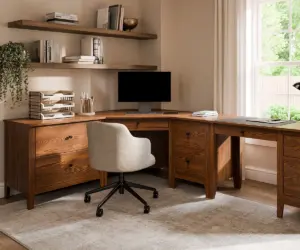
Custom Amish office furniture is a capital purchase, not a line item in the decoration budget. A solid hardwood desk built to your specifications will outlast three or four rounds of panel furniture replacements, and it won’t look tired after two years of daily use. Beyond durability, the tailored dimensions actually change how a space functions: a credenza cut to fit an awkward wall, a conference table sized for your actual headcount, a partner desk configured for two distinct workflows. Clients notice the difference. So do employees, in ways that show up in how they use and treat the space.
Ready to spec out an office that holds up as well as your work does? Talk to our team about what you’re building, dimensions, materials, timeline, and budget, and we’ll put together options that fit right for your crew!